Breaking the Invisible Circle of Myths
Faith, science and organ donation.
In a parable often told by Indian philosophers, a traveller draws a simple circle in the dirt around a domestic bird. Believing the line is a wall it cannot cross, the bird stays trapped inside: held not by bars, but by an imagined boundary.
For many years, the conversation about organ and body donation in India has been held back by a similar invisible circle, built of hesitation, superstition and misinformation. Looking at these fears through science and compassion lets us step past them.
Common myths vs. medical facts
Fact-checking common misconceptions
1. “Organ donation causes disfigurement.”
Retrieval is done by surgical specialists in an operating theatre, to the same standards of care as surgery on living patients. Afterwards the incisions are closed and dressed, and families can go ahead with traditional funeral arrangements, including an open-casket viewing.
2. “A brain-dead patient might recover.”
Under the Transplantation of Human Organs Act (THOTA), brain death can be declared only after two separate sets of tests, 6 hours apart, by a panel of four medical experts:
- the hospital’s medical superintendent
- the treating physician
- an independent specialist (neurologist or neurosurgeon)
- the doctor in charge of the patient
Transplant teams are completely separate from this certification panel.
3. “Age or minor health conditions prevent donation.”
Active communicable infections or systemic cancers can rule out some donations, but advanced age alone does not. Specialist teams assess suitability at the time of death, so everyone should pledge and let the doctors decide.
Faith, tradition and human compassion
Far from forbidding donation, the major religious traditions put compassion and the saving of life first. TFOBD works with leaders across faith communities to make these teachings clear:
Hinduism
Maharshi Dadhichi gave his own body for the welfare of others. Donating one’s body (Dehadaan) is seen as selfless giving (Daan).
Islam
Islamic scholars, including the late Maulana Wahiduddin Khan, have described organ donation as Sadqa-e-Jariyah: ongoing charity that keeps benefiting others.
Christianity
Love of one’s neighbour finds clear expression in life-saving help; organ donation is seen as an act of charity and love.
Sikhism & Jainism
Both traditions stress selfless service (Sewa) and compassion for all living beings (Jeev Daya), and support donation to relieve human suffering.
TFOBD works with interfaith leaders, parish communities, cultural groups and traditional Vasudev folk artists to share these facts. When understanding replaces hesitation, more families get the chance to save lives.
Read more: Organ donation vs. body donation · Why your family must know about your pledge
Become a donor today
EYE · SKIN · ORGAN & BODY DONATION
Registration is free and takes two minutes. One decision today can give sight, heal burns, save up to eight lives and train future doctors.
- Scan the QR code with your phone camera, or tap the button below.
- Fill in your details. It takes about two minutes.
- Receive your digital donor card instantly.
- Tell your family. At the time of death, their “yes” is what makes the donation happen.
Need help? Helpline +91 98220 49675
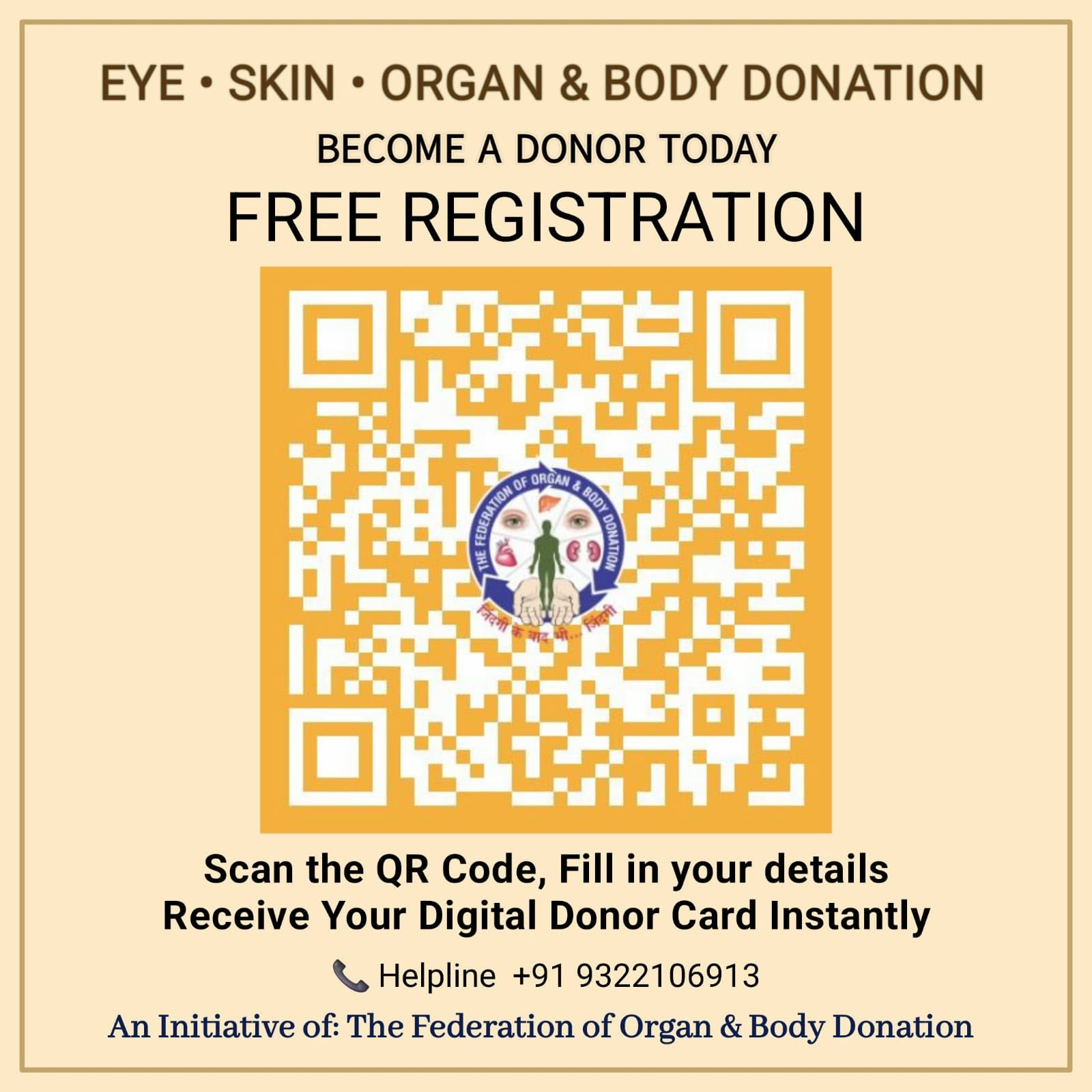 Scan with your phone camera · tap to enlarge